quantifies the correlation between the vectors a and b .

is the area of the parallelogram spanned by the vectors a and b.
Notice that

Unlike the dot product, which works in all dimensions, the cross product is special to three dimensions.
 has the value of
the determinant of the matrix consisting of a, b, and c
as row vectors. It is unchanged by cyclic permutation:
has the value of
the determinant of the matrix consisting of a, b, and c
as row vectors. It is unchanged by cyclic permutation: 
Although the cross product is strictly three-dimensional, the generalization of the triple product as a determinant is useful in all dimensions.



It quantifies the rate of change and points in the direction of greatest change.

It quantifies the tendency of neighboring vectors to point away from one another (or towards one another, if negative)
 Unlike the gradient and the
divergence, which work in all dimensions, the curl is special to three
dimensions.
Unlike the gradient and the
divergence, which work in all dimensions, the curl is special to three
dimensions.

 or,
equivalently, grad (f g) = f grad g + g grad f
or,
equivalently, grad (f g) = f grad g + g grad f 
 or, equivalently, div(f
v) = f div v + grad f . v
or, equivalently, div(f
v) = f div v + grad f . v  or, equivalently, curl(f
v) = f curl v + grad f X v
or, equivalently, curl(f
v) = f curl v + grad f X v 

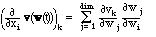
 or,
equivalently, grad f(g(x)) = f'(g(x)) grad g(x)
or,
equivalently, grad f(g(x)) = f'(g(x)) grad g(x)
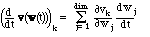
 or,
equivalently, df(w(t))/dt = grad f(w(t)) w'(t)
or,
equivalently, df(w(t))/dt = grad f(w(t)) w'(t) 
- Green's identities:


- Gauss's divergence theorem:

Stokes's theorem:

- Cartesian in spherical
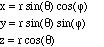
- Cartesian in cylindrical

- spherical in Cartesian
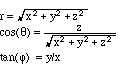
- spherical in cylindrical
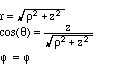
- cylindrical in Cartesian

- cylindrical in spherical